• interrupt a line of thought with a sudden new one
• say ‘uh’ between words when unsure
• accidentally blend multiple words together, and may start the sentence over again
• repeat filler words such as ‘like’ ‘literally’ ‘really’ ‘anyways’ and ‘i think’
• begin and/or end sentences with phrases such as ‘eh’ and ‘you know’, and may make those phrases into question form to get another’s input
• repeat words/phrases when in an excited state
• words fizzle out upon realizing no one is listening
• repeat themselves when others don’t understand what they’re saying, as well as to get their point across
• reply nonverbally such as hand gestures, facial expressions, random noises, movement, and even silence
Excellent sticky note for dialogue writing in fiction.
All of this. I get a lot of compliments on my dialogue and this list pretty much covers what I do (but some of it, I didn’t even realize I did, lol). I highly recommend reading your dialogue aloud (or imagining it in realtime like a movie scene) to see if it feels natural, which is what I do when editing.
File this under “super obvious yet I always seem to forget it.”
I don’t write romance (I totally respect people who do, though!) but this is also great writing advice in general! What is preventing the protagonist from achieving their goal?
Why can’t these two people be together now?
Why can’t the mystery be solved now?
Why can’t they overthrow the evil overlord now?
If you don’t have a solid answer for these questions, that’s a good indicator that the plot could use some more work.
Also test your answer a little bit. If it’s as thin as they’re just refusing to sit down and have a simple conversation, you might want to re-think how things are going.
As a beta reader/editor, I tend to ask this question a lot: “Why are they doing it this way when there’s a much easier path available?” That’s not to say that they should take the easier path, because that would usually be boring. Instead, the point is that the question needs an answer–either eliminate the easier path or give them a very clear reason for not taking it. (And if I’m asking the question, that reason isn’t as clear as you think it might be.)
I find it very difficult to root for characters who have a sensible option available and just don’t take it. If the only reason is “Because there wouldn’t be a story otherwise,” you haven’t actually found the story yet.
And this is why the Big Misunderstanding as a primary plot device is almost universally disliked.
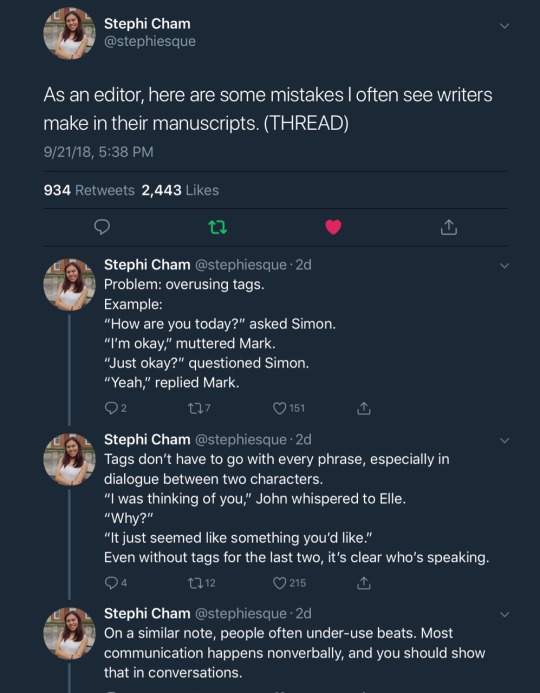
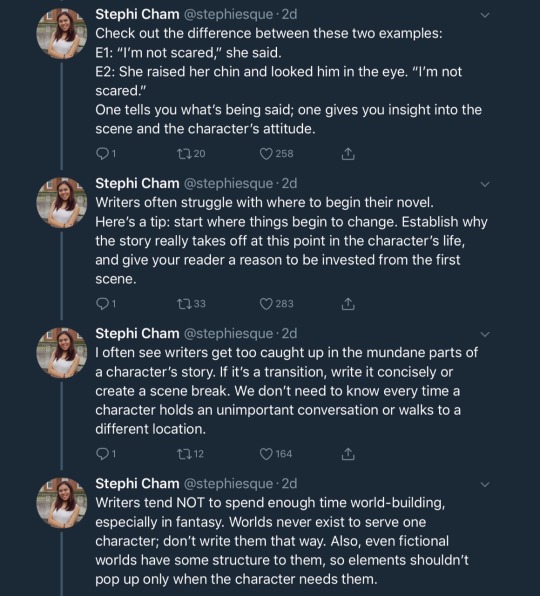
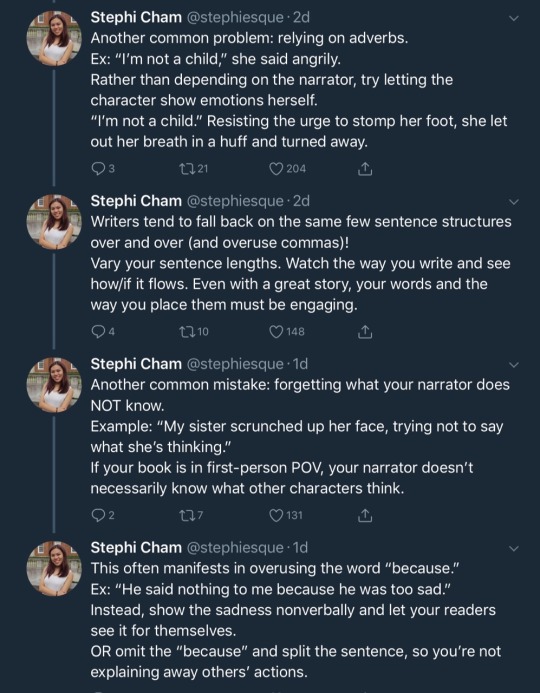
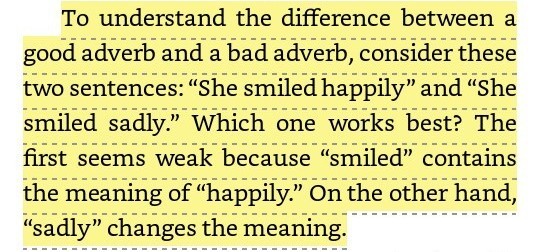
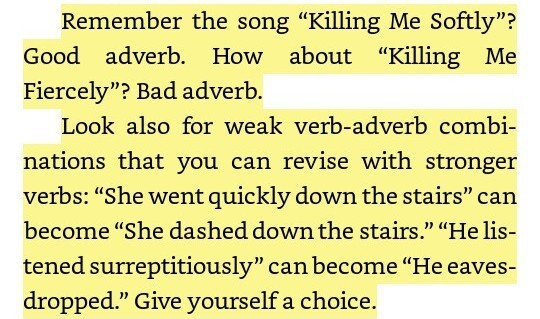
This. This is good fiction writing advice. I really appreciate how it was formatted as “this is a common problem, here is a solution to try in your own work” and not “oh god, don’t do that!” without any extra help. And I extra appreciated the “don’t rely on adverbs” bit, because they do have their place but they aren’t the only way actions can be emphasized.
Something I found that makes a scene easier and longer:
Writing the dialogue first.
I never used to do this, but one night it was really late and I was half asleep but I wanted to get some work done. So I decided to just fill in the dialogue I wanted for the scene.
I found myself with close to 1000 words of dialogue. (I obviously tagged who said what, how it was said, etc.)
When I came back to the document, I just filled in the action, the background, descriptions and plot.
I ended up with between 3000-4000 words in one sitting.
Maybe this won’t work for everyone, hell maybe someone else has already pointed this out, but I just wanted to share this writing tip.
Readers can’t resist turning pages when characters are facing tough choices. Use these 5 keys to weave moral dilemmas into your stories–and watch your fiction climb to new heights.
#1: Give Your Character Dueling Desires
Before our characters can face difficult moral decisions, we need to give them beliefs that matter: The assassin has his own moral code not to harm women or children, the missionary would rather die than renounce his faith, the father would sacrifice everything to pay the ransom to save his daughter.
A character without an attitude, without a spine, without convictions, is one who will be hard for readers to cheer for and easy for them to forget.
So, to create an intriguing character facing meaningful and difficult choices, give her two equally strong convictions that can be placed in opposition to each other.
For example: A woman wants (1) peace in her home and (2) openness between her and her husband. So, when she begins to suspect that he’s cheating on her, she’ll struggle with trying to decide whether or not to confront him about it. If she only wanted peace she could ignore the problem; if she only wanted openness she would bring it up regardless of the results. But her dueling desires won’t allow her such a simple solution.
That creates tension.
And tension drives a story forward.
So, find two things that your character is dedicated to and then make him choose between them. Look for ways to use his two desires to force him into doing something he doesn’t want to do.
For instance, a Mennonite pastor’s daughter is killed by a drunk driver. When the man is released on a technicality, does the minister forgive him (and what would that even look like?) or does he take justice into his own hands? In this case, his (1) pacifist beliefs are in conflict with his (2) desire for justice. What does he do?
Good question.
Good tension.
Good drama.
Another example: Your protagonist believes (1) that cultures should be allowed to define their own subjective moralities, but also (2) that women should be treated with the same dignity and respect as men. She can’t stand the thought of women being oppressed by the cultures of certain countries, but she also feels it’s wrong to impose her values on someone else. When she is transplanted to one of those countries, then, what does she do?
Construct situations in which your character’s equally strong convictions are in opposition to each other, and you will create occasions for thorny moral choices.
#2: Put Your Character’s Convictions to the Test
We don’t usually think of it this way, but in a very real sense, to bribe someone is to pay him to go against his beliefs; to extort someone is to threaten him unless he goes against them.
For example:
How much would you have to pay the vegan animal rights activist to eat a steak (bribery)? Or, how would you need to threaten her in order to coerce her into doing it (extortion)?
What would it cost to get the loving, dedicated couple to agree never to see each other again (bribery)? Or, how would you need to threaten them to get them to do so (extortion)?
What would you need to pay the pregnant teenage Catholic girl to convince her to have an abortion (bribery)? What threat could you use to get her to do it (extortion)?
Look for ways to bribe and extort your characters. Don’t be easy on them. As writers we sometimes care about our characters so much that we don’t want them to suffer. As a result we might shy away from putting them into difficult situations.
Guess what?
That’s the exact opposite of what needs to happen in order for our fiction to be compelling.
What’s the worst thing you can think of happening to your character, contextually, within this story? Now, challenge yourself—try to think of something else just as bad, and force your character to decide between the two.
Plumb the depths of your character’s convictions by asking, “How far will s/he go to … ?” and “What would it take for … ?”
(1) How far will Frank go to protect the one he loves?
(2) What would it take for him to stand by and watch the one he loves die when he has the power to save her?
(1) How far will Angie go to find freedom?
(2) What would it take for her to choose to be buried alive?
(1) How far will Detective Rodriguez go to pursue justice?
(2) What would it take for him to commit perjury and send an innocent person to death row?
Ask yourself: What does my character believe in? What priorities does she have? What prejudices does she need to overcome? Then, put her convictions to the ultimate test to make her truest desires and priorities come to the surface.
#3: Force Your Character into a Corner
Don’t give him an easy out. Don’t give him any wiggle room. Force him to make a choice, to act. He cannot abstain. Take him through the process of dilemma, choice, action and consequence:
(1) Something that matters must be at stake.
(2) There’s no easy solution, no easy way out.
(3) Your character must make a choice. He must act.
(4) That choice deepens the tension and propels the story forward.
(5) The character must live with the consequences of his decisions and actions.
If there’s an easy solution there’s no true moral dilemma. Don’t make one of the choices “the lesser of two evils”; after all, if one is lesser, it makes the decision easier.
For example, say you’ve taken the suggestion in the first key above and forced your character to choose between honoring equal obligations. He could be caught between loyalty to two parties, or perhaps be torn between his family obligations and his job responsibilities. Now, raise the stakes—his marriage is at risk and so is his job, but he can’t save them both. What does he do?
The more imminent you make the choice and the higher the stakes that decision carries, the sharper the dramatic tension and the greater your readers’ emotional engagement. To achieve this, ask “What if?” and the questions that naturally follow:
What if she knows that being with the man she loves will cause him to lose his career? How much of her lover’s happiness would she be willing to sacrifice to be with him?
What if an attorney finds herself defending someone she knows is guilty? What does she do? What if that person is her best friend?
What if your character has to choose between killing himself or being forced to watch a friend die?
Again, make your character reevaluate his beliefs, question his assumptions and justify his choices. Ask yourself: How is he going to get out of this? What will he have to give up (something precious) or take upon himself (something painful) in the process?
Explore those slippery slopes. Delve into those gray areas. Avoid questions that elicit a yes or no answer, such as: “Is killing the innocent ever justified?” Instead, frame the question in a way that forces you to take things deeper: “When is killing the innocent justified?” Rather than, “Does the end justify the means?” ask, “When does the end justify the means?”
#4: Let the Dilemmas Grow From the Genre
Examine your genre and allow it to influence the choices your character must face. For instance, crime stories naturally lend themselves to exploring issues of justice and injustice: At what point do revenge and justice converge? What does that require of this character? When is preemptive justice really injustice?
Love, romance and relationship stories often deal with themes of faithfulness and betrayal: When is it better to hide the truth than to share it? How far can you shade the truth before it becomes a lie? When do you tell someone a secret that would hurt him? For example, your protagonist, a young bride-to-be, has a one-night stand. She feels terrible because she loves her fiancé, but should she tell him what happened and shatter him—and perhaps lose him—or keep the truth hidden?
Fantasy, myth and science fiction are good venues for exploring issues of consciousness, humanity and morality: How self-aware does something need to be (an animal, a computer, an unborn baby) before it should be afforded the same rights as fully developed humans? At what point does destroying an AI computer become murder? Do we really have free will or are our choices determined by our genetic makeup and environmental cues?
#5: Look the Third Way
You want your readers to be thinking, I have no idea how this is going to play out. And then, when they see where things go, you want them to be satisfied.
There’s a story in the Bible about a time religious leaders caught a woman committing adultery and brought her to Jesus. In those days, in that culture, adultery was an offense that was punishable by death. The men asked Jesus what they should do with this woman. Now, if Jesus had told them to simply let her go free he would have been contravening the law; if, however, he told them to put her to death, he would have undermined his message of “forgiveness and mercy.”
It seemed like a pretty good trap, until he said, “Whoever is without sin among you, let him cast the first stone.”
Nicely done.
I call this finding the Third Way. It’s a solution that’s consistent with the character’s attitude, beliefs and priorities, while also being logical and surprising.
We want the solutions that our heroes come up with to be unexpected and inevitable.
Present yours with a seemingly impossible conundrum.
And then help him find the Third Way out.
I hope this helped! I’ve been really busy today, seeing how my mom had surgery and I’ve been trying to continue writing my novel today as well. I thought I’d squeeze in some more stuff for you guys!
If you have any questions or just want to talk, feel free to visit my ask box!
“Stress. It makes your heart pound, your breathing quicken and your forehead sweat. But while stress has been made into a public health enemy, new research suggests that stress may only be bad for you if you believe that to be the case. Psychologist Kelly McGonigal urges us to see stress as a positive, and introduces us to an unsung mechanism for stress reduction: reaching out to others.”
Why do people succeed? Is it because they’re smart? Or are they just lucky? Neither. Analyst Richard St. John condenses years of interviews into an unmissable 3-minute slideshow on the real secrets of success.
Can we break bad habits by being more curious about them? Psychiatrist Judson Brewer studies the relationship between mindfulness and addiction — from smoking to overeating to all those other things we do even though we know they’re bad for us. Learn more about the mechanism of habit development and discover a simple but profound tactic that might help you beat your next urge to smoke, snack or check a text while driving.
We’re taught to try to live life without regret. But why? Using her own tattoo as an example, Kathryn Schulz makes a powerful and moving case for embracing our regrets.
Here’s a talk that could literally change your life. Which career should I pursue? Should I break up — or get married?! Where should I live? Big decisions like these can be agonizingly difficult. But that’s because we think about them the wrong way, says philosopher Ruth Chang. She offers a powerful new framework for shaping who we truly are.
We spend so much time listening to the things people are saying that we rarely pay attention to the things they don’t,“ says poet and teacher Clint Smith. A short, powerful piece from the heart, about finding the courage to speak up against ignorance and injustice.
Have you ever felt like you’re talking, but nobody is listening? Here’s Julian Treasure to help. In this useful talk, the sound expert demonstrates the how-to’s of powerful speaking — from some handy vocal exercises to tips on how to speak with empathy. A talk that might help the world sound more beautiful.
Body language affects how others see us, but it may also change how we see ourselves. Social psychologist Amy Cuddy shows how “power posing” — standing in a posture of confidence, even when we don’t feel confident — can affect testosterone and cortisol levels in the brain, and might even have an impact on our chances for success.
We believe we should work hard in order to be happy, but could we be thinking about things backwards? In this fast-moving and very funny talk, psychologist Shawn Achor argues that, actually, happiness inspires us to be more productive.
At TEDWomen, Tony Porter makes a call to men everywhere: Don’t “act like a man.” Telling powerful stories from his own life, he shows how this mentality, drummed into so many men and boys, can lead men to disrespect, mistreat and abuse women and each other. His solution: Break free of the “man box.”


 RandomFandom